The universe was expected to be crowded with tiny galaxies, especially in its earliest stages. Astronomers long believed that smaller galaxies should vastly outnumber larger ones. However, a recent study suggests this assumption may be flawed.
Researchers now question why the smallest galaxies appear to be missing. The study indicates that far fewer tiny galaxies existed in the early universe than theoretical models predicted. This finding carries major implications for understanding how the universe evolved.
For decades, scientists assumed that observing deeper into space would reveal endless numbers of faint, low-mass galaxies. The logic seemed straightforward. Smaller structures should form more easily and in greater numbers.
A new analysis led by Xuheng Ma from the University of Wisconsin challenges that view. The study, recently posted on the arXiv preprint database, suggests many tiny galaxies may have vanished before they could be observed. This possibility forces astronomers to reconsider events following the cosmic dark ages.
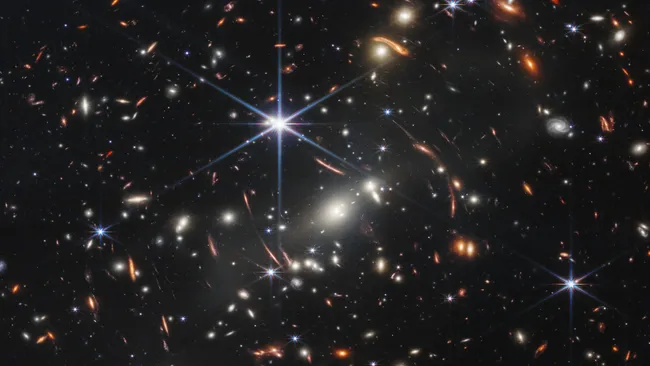
To investigate these elusive objects, the team focused on Abell 2744. This massive galaxy cluster contains enormous amounts of dark matter and stars. Its gravity distorts space-time, creating a phenomenon known as gravitational lensing.
Gravitational lensing magnifies distant objects by bending their light. This natural effect allows astronomers to observe galaxies that would otherwise remain invisible. Abell 2744 effectively acts as a cosmic telescope.
Using data from the James Webb Space Telescope’s UNCOVER program, researchers examined galaxies from the Epoch of Reionization. This period occurred roughly 12 to 13 billion years ago, when the first stars transformed the universe.
During this era, ultraviolet radiation from early stars stripped electrons from hydrogen atoms. This process turned the universe from opaque to transparent. Scientists previously believed tiny galaxies powered most of this transformation.
Astronomers analyze galaxy populations using luminosity functions. These charts compare the number of bright galaxies to faint ones. Historically, such graphs showed a steady rise in faint galaxy counts.
The new study revealed a different pattern. Instead of continuously increasing, the number of faint galaxies peaked and then declined. This phenomenon is known as faint-end suppression.
Faint-end suppression indicates that below a certain brightness, galaxies become increasingly rare. This result contradicts older models that predicted countless tiny galaxies. The universe may not be as densely populated as once thought.
One explanation involves intense radiation from early massive stars. This radiation likely heated surrounding gas to extreme temperatures. Small galaxies may have been unable to retain this gas.
Without gas, star formation would have stalled. These galaxies would remain dark and effectively invisible. Over time, they may have faded into cosmic obscurity.
The findings rely heavily on accurate models of Abell 2744’s dark matter distribution. Errors in the lensing map could affect galaxy counts. However, the analysis suggests the suppression trend is genuine.
If tiny galaxies are missing, they could not have driven reionization alone. Scientists may need to credit larger, more stable galaxies with that role. This shift alters long-standing views of cosmic history.
Further observations are required to confirm whether this trend appears elsewhere. Additional galaxy clusters and lensing systems will help verify the results.
Future data from the James Webb Space Telescope and upcoming surveys will provide clarity. For now, the early universe appears emptier than expected. At the same time, it has become far more intriguing to study.