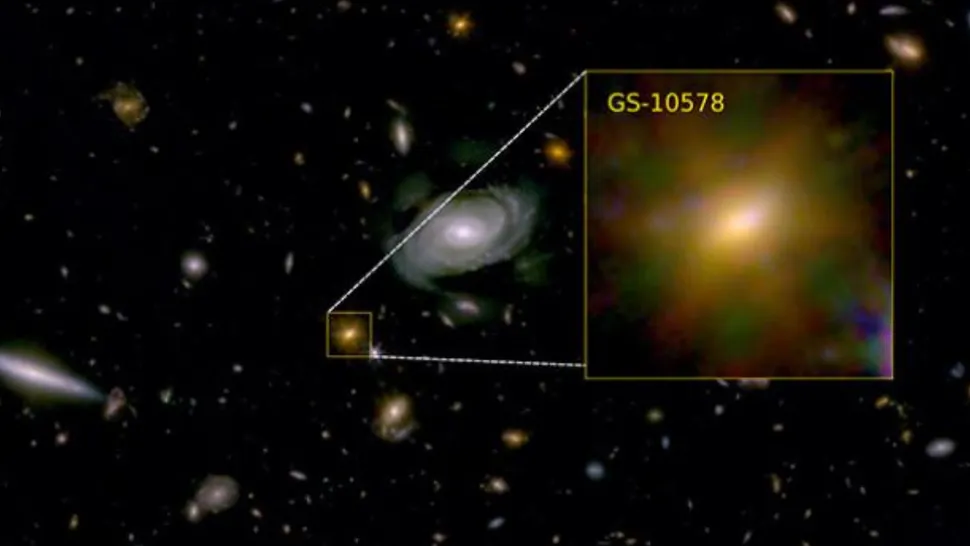
Astronomers have uncovered how a supermassive black hole gradually destroyed a young galaxy in a process likened to a cosmic “death by a thousand cuts.”
The doomed system, officially named GS-10578 and widely known as Pablo’s Galaxy, was examined using the James Webb Space Telescope and the Atacama Large Millimeter/submillimeter Array.
Light from Pablo’s Galaxy has traveled for roughly 11 billion years before reaching Earth. This allows scientists to observe the galaxy as it existed only three billion years after the Big Bang.
Despite its young cosmic age, Pablo’s Galaxy was unusually massive. Researchers estimate its mass to be equivalent to nearly 200 billion suns.
Most of its stars formed between 12.5 and 11.5 billion years ago. However, star formation abruptly stopped soon afterward.
Astronomers describe a galaxy as “dead” once it no longer forms stars. By that definition, Pablo’s Galaxy lived fast and faded early.
Initial observations published in September 2024 used data from the James Webb Space Telescope alone. These findings revealed powerful outflows driven by the central black hole.
Gas was being expelled at speeds reaching 2.2 million miles per hour. At such velocities, star-forming material could escape the galaxy entirely.
Later observations added data from ALMA, a network of 66 radio telescopes located in northern Chile. The team searched for carbon monoxide as a tracer of cold hydrogen gas.
No detectable signal was found. This absence strongly suggested that the galaxy had already lost its cold gas reserves.
According to researcher Jan Scholtz from the University of Cambridge, the lack of detection was itself a critical result. The data pointed to slow starvation rather than a single catastrophic event.
Further observations with the James Webb Space Telescope revealed that the galaxy is losing gas at a rate of around 60 solar masses per year.
At this pace, Pablo’s Galaxy would have exhausted its star-forming fuel within 16 to 220 million years. This is far shorter than the typical billion-year timescale seen in similar galaxies.
Despite its decline, the galaxy still appears visually calm. It maintains the structure of a rotating disk.
This suggests it did not experience a major merger with another galaxy. Nevertheless, star formation ended around 400 million years ago.
Researchers reconstructed the galaxy’s history and concluded that expelled gas was repeatedly prevented from falling back inward. This blocked the replenishment of material needed to form new stars.
The black hole did not eject all gas at once. Instead, it went through multiple cycles of activity that continuously suppressed recovery.
Team member Francesco D’Eugenio explained that the current outflow did not directly cause the shutdown. Repeated black hole episodes likely prevented the fuel from returning.
These findings may help explain why the James Webb Space Telescope has identified many ancient-looking galaxies in the early universe.
According to the researchers, a galaxy does not need a single violent event to stop forming stars. Preventing fresh gas from entering can be enough.
With combined JWST and ALMA observations proving effective, astronomers plan further studies. Future data may reveal more details about how black holes quietly end galaxies long before their time.