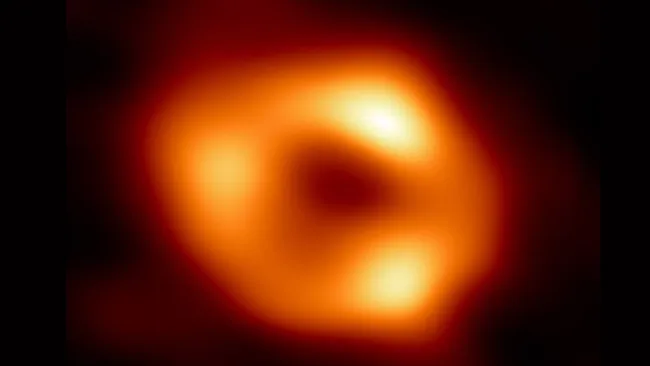
The supermassive black hole at the center of the Milky Way has long been viewed as a dormant cosmic giant. New findings show this assumption was incorrect. Data from an international X-ray spacecraft reveal that Sagittarius A* experienced violent outbursts in the recent cosmic past.
Observations indicate that Sagittarius A*, also known as Sgr A*, released intense X-ray flares over the last 1,000 years. The discovery was made using XRISM, a joint mission involving Japan, Europe, and the United States. This evidence challenges previous ideas about the calm nature of the Milky Way black hole.
The XRISM spacecraft, short for X-Ray Imaging and Spectroscopy Mission, provides unprecedented insight into black hole behavior. Scientists believe these findings may reshape theories on how supermassive black holes evolve. The role of such objects in shaping entire galaxies may require reassessment.
Researchers expressed surprise at the results. Team leader Stephen DiKerby from Michigan State University stated that his professional background did not prepare him for such observations. He emphasized that XRISM offers entirely new tools for studying X-ray phenomena.
Although black holes emit no light directly, their surroundings can shine intensely. Matter orbiting a black hole becomes extremely hot due to friction and gravitational forces. This process can generate powerful X-ray flares that briefly illuminate the region.
Sagittarius A* has a mass equal to about four million suns. Until now, it was not known for producing strong emissions. The XRISM data reveal that this quiet phase followed a far more turbulent history.
The research team uncovered this activity by observing a massive molecular cloud near the galactic center. XRISM detected detailed X-ray signals emitted by this cloud. Analysis showed the cloud was reflecting ancient X-ray flares from Sagittarius A*, acting as a cosmic mirror.
XRISM’s advanced sensitivity made it possible to measure X-ray energies with exceptional precision. This allowed scientists to track the motion of the molecular cloud accurately. Alternative explanations, including cosmic rays, were ruled out as the source of the emissions.
Launched in 2023, XRISM demonstrated its capability to explore the universe in fine detail. The mission is operated jointly by NASA, JAXA, and ESA. Researchers believe it can uncover hidden chapters in cosmic history.
DiKerby concluded that the team was fortunate to apply new methods to groundbreaking data. He noted that moments like this define the excitement of astronomy. Seeing the universe in a way no human has before remains a defining motivation for exploration.