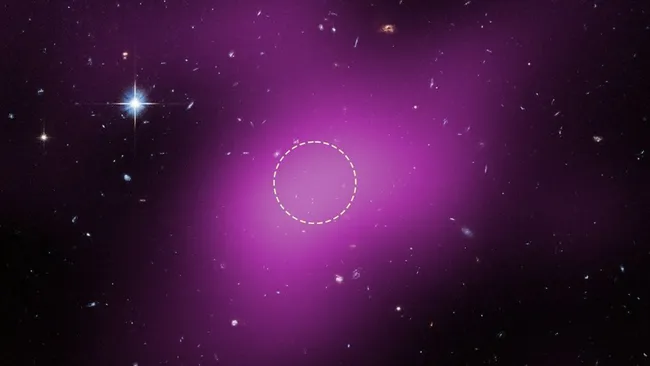
Astronomers working with the Hubble Space Telescope have identified a new kind of cosmic object. The discovery involves a cloud made of dark matter and gas that contains no stars.
The object sits roughly 14 million light-years from Earth. It lies on the outer edge of the spiral galaxy Messier 94, also known as M94.
Researchers have nicknamed the object “Cloud 9.” The name reflects both its cloud-like structure and the excitement surrounding its scientific value.
Scientists believe Cloud 9 could help explain how galaxies formed in the early universe. The object may also provide rare insight into the nature of dark matter.
Andrew Fox from AURA/STScI, speaking on behalf of the European Space Agency, described Cloud 9 as a direct view into the dark universe. He explained that most mass in the universe is expected to be dark matter, yet it remains difficult to detect.
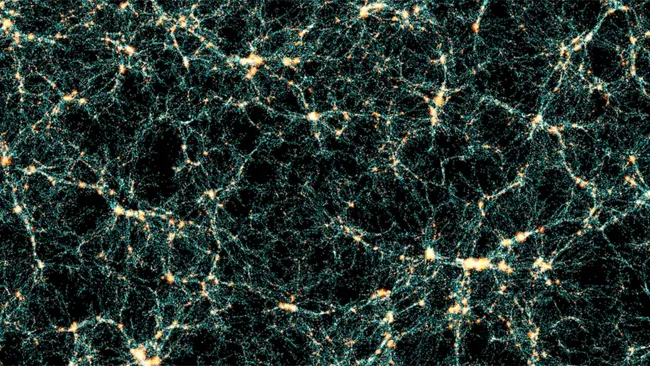
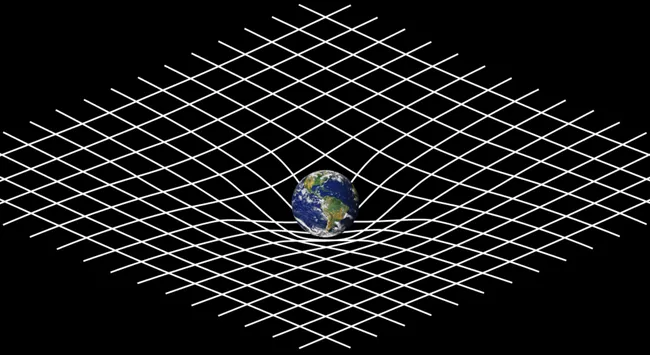
Dark matter does not emit light. As a result, astronomers can only observe its effects through gravity and its influence on visible matter.
It is estimated that dark matter accounts for around 85 percent of the universe’s total mass. Despite this dominance, it remains invisible to conventional observation methods.
Dark matter outweighs the particles that form stars, planets, and all visible structures. It is believed to have played a major role in shaping the early cosmos.
Regions where dark matter first gathered created intense gravitational zones. These areas eventually led to the formation of the first stars and galaxies.
Cloud 9 appears to follow this pattern, but with a key difference. The cloud is dominated by dark matter, yet star formation never began.
The object is classified as a Reionization-Limited Hydrogen I Cloud, or RELHIC. Inside it, hydrogen gas has started to collect.
Under normal conditions, this process would trigger star birth. In the case of Cloud 9, star formation failed to occur.
Researchers believe the cloud did not accumulate enough gas to initiate stellar development. This makes it a fossil remnant of a failed galaxy.
Alejandro Benitez-Llambay from the University of Milano-Bicocca described Cloud 9 as an example of a galaxy that never formed. He noted that scientific failures often reveal more than successes.
The absence of stars supports existing theories. It suggests that astronomers have identified a primordial building block of a galaxy in the nearby universe.
For decades, scientists predicted that RELHICs should exist. Without Hubble, such objects would have remained theoretical.
Before Hubble observations, Cloud 9 could have been mistaken for a faint dwarf galaxy. Ground-based telescopes lacked the sensitivity to confirm the absence of stars.
Using Hubble’s Advanced Camera for Surveys, researchers confirmed that no stars exist within the cloud. This eliminated alternative explanations.
The discovery suggests that many similar stalled galaxies may exist throughout the universe. These objects may be waiting to be found.
One researcher compared them to abandoned houses scattered among galactic neighborhoods. The analogy highlights how overlooked these structures can be.
Cloud 9 differs from hydrogen clouds near the Milky Way. It is smaller, denser, and nearly spherical in shape.
Its core consists of neutral hydrogen and spans about 4,900 light-years. The hydrogen mass is estimated at roughly one million solar masses.
By contrast, the dark matter mass of Cloud 9 is far larger. Estimates place it at around five billion times the mass of the Sun.
Scientists believe Cloud 9 could still evolve into a full galaxy. This would require the accumulation of a massive amount of hydrogen gas.
Until then, its lack of stars makes it an ideal laboratory. Researchers can study dark matter without interference from stellar light.
Future astronomical surveys will now search for similar objects. Astronomers hope to uncover more failed galaxy RELHICs in the cosmos.