NASA administrator Jared Isaacman indicated that Texas may ultimately receive a different historic spacecraft, not the space shuttle Discovery, amid ongoing debate over relocating the orbiter from Virginia to Houston. The statement potentially complicates plans backed by Texas lawmakers seeking to bring the iconic shuttle to the Johnson Space Center.
Speaking in a CNBC interview on December 27, Isaacman explained that a vehicle choice had already been made under his predecessor. He said his current responsibility is to determine whether such a transfer can be completed within budget limits while ensuring the spacecraft’s safety. Isaacman formally assumed leadership of NASA on December 18, one day after Senate confirmation.
The proposal to move space shuttle Discovery was championed by Senators Ted Cruz and John Cornyn of Texas. Their initiative was embedded in the One Big Beautiful Bill Act, which President Donald Trump signed into law during the summer. The senators argued that Houston deserves a flagship human spaceflight artifact, given its role as home to astronaut training and Mission Control.
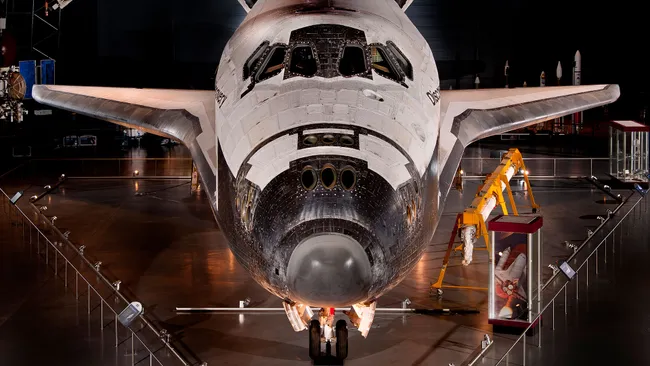
Space shuttle Discovery is NASA’s most-flown orbiter. The spacecraft completed 39 missions between 1984 and 2011, when the shuttle program ended. Other retired shuttles are already displayed across the United States. Atlantis resides in Florida, Endeavour is housed in California, and the Enterprise test vehicle is exhibited in New York City.
Two shuttles, Challenger and Columbia, were lost in fatal accidents in 1986 and 2003. Their destruction remains a defining chapter in NASA’s history.
Despite political support, moving Discovery presents multiple obstacles. NASA transferred ownership of the orbiter to the Smithsonian Institution in 2012. Any relocation would require the federal government to reclaim the spacecraft from the museum.
Cost is another major concern. While the legislation allocated 85 million dollars for the move, critics argue the figure falls far short. Officials at the Smithsonian’s Steven F. Udvar-Hazy Center estimate transportation alone could reach 150 million dollars, excluding construction of a new display facility.
Physical logistics add further complications. Discovery measures 122 feet in length and spans 78 feet across its wings. The shuttle originally arrived at the Udvar-Hazy Center atop a modified Boeing 747. NASA’s Shuttle Carrier Aircraft fleet has since been retired, limiting available transport options.
Smithsonian officials have warned that partial disassembly may be required to relocate Discovery. That process could expose the orbiter to serious structural risk.
Against this backdrop, NASA chief Jared Isaacman emphasized that safety and cost will drive the final decision. He suggested alternative solutions if moving Discovery proves impractical.
Isaacman pointed to spacecraft involved in the Artemis program. NASA plans to send crews around the moon on Artemis 2 as early as February 2026. The agency is also targeting a lunar landing with Artemis 3 by 2028, followed by Artemis 4 and Artemis 5 missions.
Those missions will rely on the Orion spacecraft launched atop the Space Launch System rocket. Isaacman hinted that one of these lunar-capable vehicles could instead become the historic spacecraft destined for Houston.
He concluded that, regardless of the final outcome, NASA will ensure the Johnson Space Center receives a spacecraft worthy of its legacy in human spaceflight.