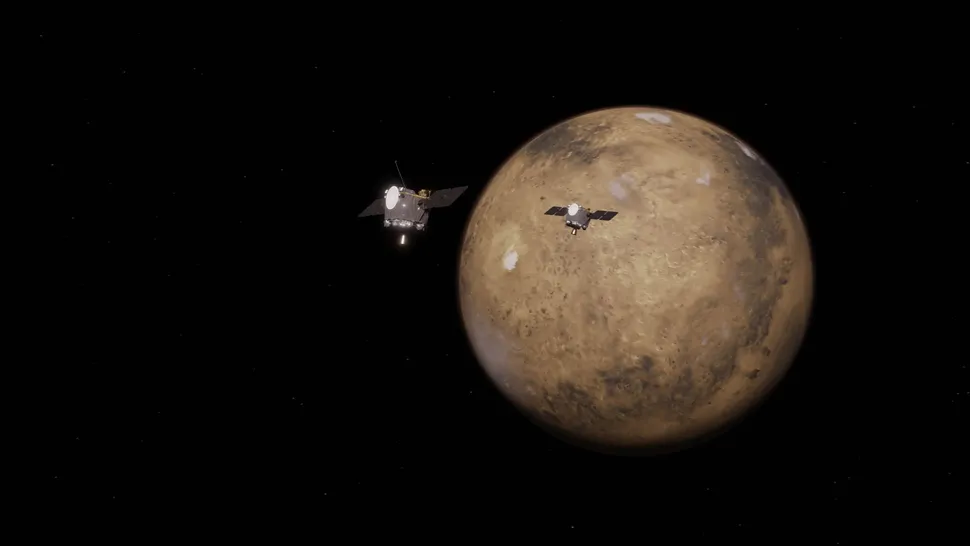
After years of delays and uncertainty, NASA’s Escape and Plasma Acceleration and Dynamics Explorers, known as ESCAPADE, has finally begun its indirect journey toward Mars. The mission launched on November 13, 2025, aboard Blue Origin’s New Glenn rocket.
ESCAPADE consists of two small spacecraft designed to map Mars’ magnetic field and examine how the solar wind has stripped away the planet’s atmosphere over billions of years. The mission marks an important step for low-cost planetary exploration.
As part of NASA’s Small Innovative Missions for Planetary Exploration, or SIMPLEx, program, ESCAPADE operates under a higher-risk, lower-budget model. These missions prioritize affordability and speed over the exhaustive testing typical of flagship projects.
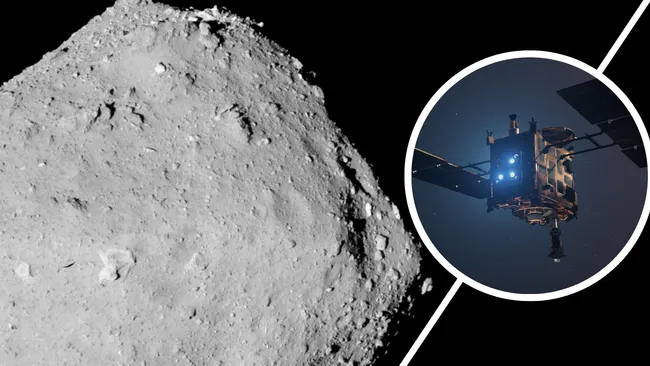
The SIMPLEx track has faced mixed results so far. Several missions encountered failures or indefinite delays, underscoring the financial and technical risks tied to this approach. ESCAPADE itself will not begin returning scientific data for approximately 30 months.
Despite those odds, the rationale remains clear. If enough low-cost missions succeed, NASA can still achieve meaningful scientific returns while spending far less overall.
NASA classifies ESCAPADE as a Class D mission, the category with the highest risk tolerance and lower complexity. Historically, Class D missions rarely launch on schedule and often exceed their original budgets.
ESCAPADE has remained under the 100 million dollar threshold through aggressive cost controls. The spacecraft uses a minimal instrument suite, lightweight design, and commercial off-the-shelf components rather than custom-built systems.
Private companies played a central role in development. Rocket Lab handled much of the spacecraft construction, while Advanced Space LLC designed the mission trajectory under strict budget limits.
Additional savings came from creative partnerships. The VISIONS camera package was funded by a university program, and the launch benefited from a discounted ride on New Glenn, which Blue Origin was already preparing for internal testing.
The mission launched during a major shift in space exploration. Government space budgets are under pressure, while commercial launch capabilities are rapidly expanding.
Reusable rockets from companies such as SpaceX and Blue Origin are reducing launch costs and reshaping mission economics. This trend has revived interest in NASA’s long-standing “faster, better, cheaper” philosophy.
Supporters argue that multiple smaller missions can outperform a single flagship project in total scientific output. Critics note that smaller missions cannot match the technological breakthroughs or broad discovery potential of large observatories.
ESCAPADE’s scientific goals are intentionally narrow. The mission focuses on Mars’ magnetic environment and atmospheric loss, building on findings from earlier missions such as MAVEN.
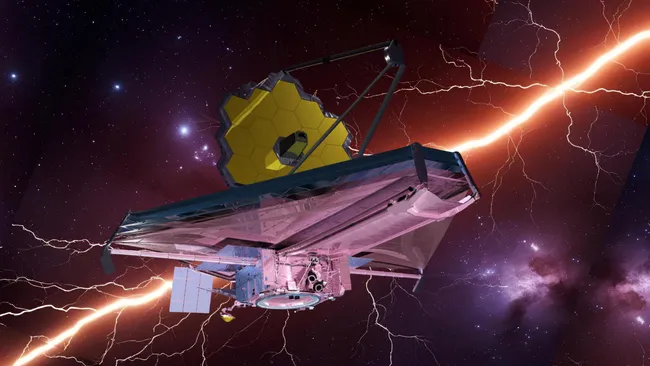
Flagship missions like the James Webb Space Telescope continue to drive major technological advances. Those innovations often benefit future missions and everyday technologies, an advantage smaller missions rarely provide.
ESCAPADE’s path to launch was turbulent. The project survived numerous near-cancellations, lost an earlier launch opportunity, and faced repeated delays due to weather, technical issues, and regulatory constraints.
The successful launch in November 2025 marked a major milestone. After initial communication challenges, mission controllers confirmed contact with both spacecraft.
If ESCAPADE reaches Mars and delivers its planned data, it will strengthen the case for commercially supported, low-cost science missions. However, such efforts are unlikely to replace flagship missions entirely.
Instead, ESCAPADE may help define a balanced future. A mix of small, affordable missions and a limited number of ambitious flagships could sustain planetary science during an era of tightening budgets.
For now, ESCAPADE remains an ongoing experiment. Its ultimate impact will depend on whether its promise translates into scientific results.