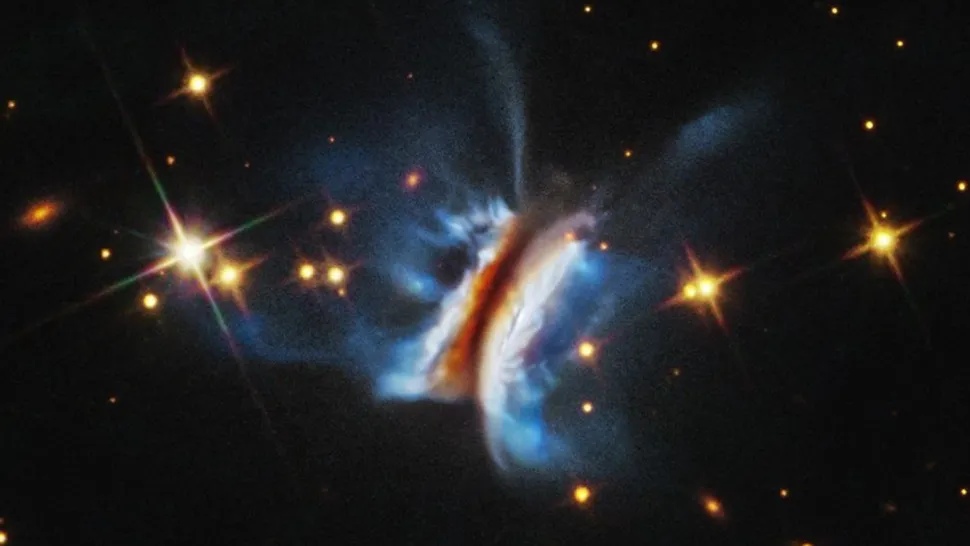
Using the Hubble Space Telescope, astronomers have captured an image of the largest and most turbulent region of planetary formation ever observed. The discovery offers a rare and detailed look into how planets may emerge from chaotic cosmic environments.
The object appears like a dramatic cosmic bat suspended in space. This enormous protoplanetary disk lies roughly 1,000 light-years from Earth and spans nearly 400 billion kilometers. Its size is estimated at about 40 times larger than our solar system, extending well beyond a region comparable to the Kuiper Belt.
At the center of this vast structure sits a young star surrounded by swirling gas and dust. Officially cataloged as IRAS 23077+6707, the system is better known by its memorable nickname, “Dracula’s Chivito.” The name reflects both its unusual shape and the personalities behind its discovery.
What sets Dracula’s Chivito apart is not only its immense scale. According to researchers, the clarity and complexity visible in the Hubble Space Telescope image are rarely achieved in observations of protoplanetary disks.
Kristina Monsch, lead researcher from the Center for Astrophysics | Harvard & Smithsonian, explained that the disk is viewed almost edge-on. This orientation exposes wispy upper layers and uneven structures that reveal intense activity within the disk.
Monsch noted that both Hubble and the James Webb Space Telescope have detected similar features in other systems. However, Dracula’s Chivito provides an exceptional angle that allows scientists to trace internal substructures in visible light with unprecedented detail.
This unique perspective turns the system into a natural laboratory for studying planet formation. Researchers can examine how disks evolve and interact with their environments as planets begin to emerge.
The uneven lanes of gas and dust seen in the image suggest strong dynamic forces at work. Interactions with surrounding material appear to be reshaping the disk over time, contributing to its asymmetrical appearance.
Astronomer Joshua Bennett Lovell described the team’s reaction as one of surprise. He emphasized that the level of asymmetry highlights how chaotic the planet-building process can be, offering new opportunities to study mechanisms that are still not fully understood.
Beyond its immediate scientific value, Dracula’s Chivito also provides a glimpse into the distant past. The system may resemble what our own solar system looked like around 4.6 billion years ago, though on a much grander scale.
Monsch suggested that IRAS 23077+6707 could potentially host an extensive planetary system. While planet formation in such massive disks may vary, the fundamental processes are believed to remain comparable.
The findings raise many new questions for astronomers. Even so, the images serve as an important starting point for understanding how planets form over long periods and across diverse cosmic environments.
The nickname “Dracula’s Chivito” has a lighter backstory. “Dracula” references the Transylvanian heritage of one research team member, while “Chivito” refers to a famous Uruguayan steak sandwich, honoring another scientist’s homeland.
Despite the name, there is nothing supernatural here. This dramatic structure is simply a reminder of how wild and energetic the universe can be when building new worlds.