Russia has officially patented a new space station concept designed to generate artificial gravity, marking a notable development in spacecraft architecture. The patent was secured by Energia, the Russian state-owned rocket and spacecraft company, and outlines a system intended to support long-duration human spaceflight.
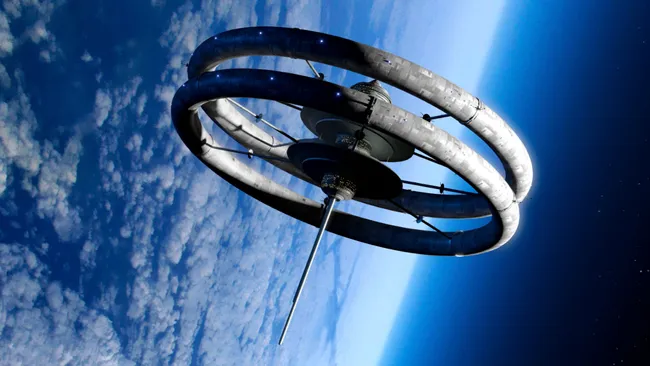
According to a report from Russian state media outlet TASS, the patented design relies on a rotating structure capable of producing artificial gravity equal to 0.5g, or half of Earth’s gravitational force. The documentation describes a conceptual space station featuring a central axial module that combines static and rotating elements.
In the proposed design, various modules and crew habitats are connected through a flexible, hermetically sealed junction. Habitable sections are positioned radially and rotate around the station’s central axis, creating artificial gravity through centrifugal force that pushes occupants outward.
To achieve the targeted 0.5g environment, the rotating modules would need to spin at approximately five revolutions per minute. The design specifies a rotation radius of about 131 feet, or 40 meters. A space station of this scale would require multiple launches, with individual modules assembled in orbit.
The patent also acknowledges technical drawbacks associated with the system. One highlighted challenge is the need to synchronize the rotation of visiting spacecraft during docking procedures. According to the documentation, this requirement could reduce overall operational safety compared to non-rotating stations.
Despite these challenges, artificial gravity in space could significantly benefit astronauts on extended missions. Prolonged exposure to microgravity is known to cause muscle atrophy, bone density loss, and other physiological issues that complicate long-term human spaceflight.
Various space agencies and private companies have explored similar ideas. NASA previously introduced concepts such as the Nautilus-X rotating space station, while commercial firm Vast has more recently announced plans to pursue artificial gravity stations.
Russia has not disclosed a development timeline or allocated resources for building the patented station. However, the move signals continued interest in artificial gravity solutions as the International Space Station approaches the end of its operational life and new national and commercial space station initiatives take shape.