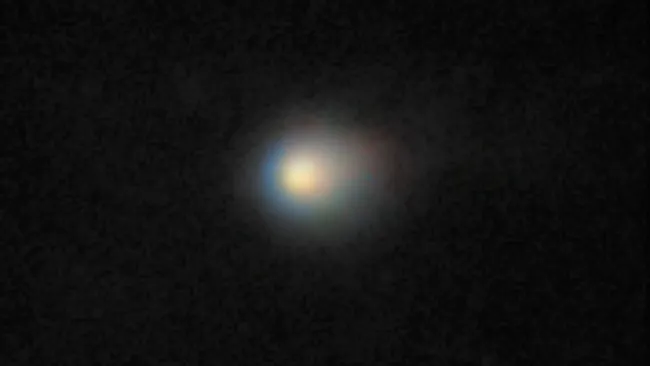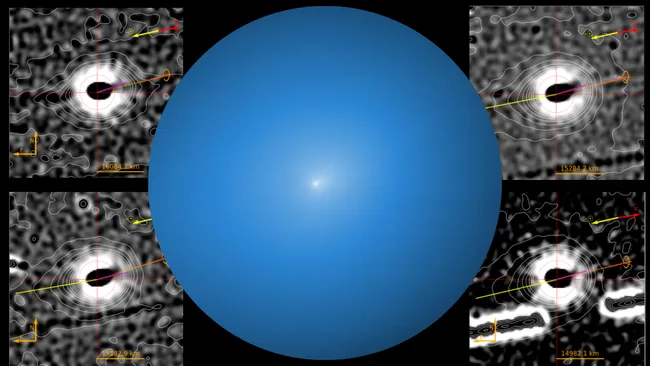
Interstellar comet 3I/ATLAS may already be moving away from Earth and heading toward the edge of the solar system. Even so, the object continues to surprise scientists with unexpected behavior. Recent observations reveal that the interstellar comet 3I/ATLAS produces wobbling jets within a rare sun-facing anti-tail.
New research shows that jet structures inside the anti-tail were oscillating every 7 hours and 45 minutes as the comet approached the sun. Some observations estimate the sun-facing tail extended up to 620,000 miles, or about one million kilometers. This phenomenon adds to the growing interest in wobbling jets comet behavior.
Comets are typically known for tails and surrounding haloes made of gas and dust. These features form when solar radiation heats the comet’s nucleus and pushes material outward. In most cases, comet tails extend away from the sun. A sun-facing anti-tail, however, is a rare formation that points toward the sun instead of away from it.
The interstellar comet 3I/ATLAS is only the third known object confirmed to have entered the solar system from another star system. The first was ‘Oumuamua, discovered in October 2017. The second was interstellar comet 2I/Borisov, observed in August 2019. While sun-facing anti-tails have been seen in comets originating within the solar system, this is the first time such outgassing has been documented in an interstellar visitor.
Researchers noted that studying the jets of 3I/ATLAS provides a rare scientific opportunity. The comet is considered a pristine body formed in a different planetary system. Its physical behavior offers clues about materials and processes beyond the solar system.
The wobbling jets were detected within the coma of 3I/ATLAS after observations conducted over 37 nights. Data were collected between July 2 and September 5, 2025, using the Two-meter Twin Telescope. This robotic telescope operates at the Teide Observatory in Tenerife, Canary Islands.
During this period, scientists tracked changes in the comet’s coma structure. Initially, the dust appeared as a sun-facing fan. As time progressed, it evolved into a more pronounced antisolar tail. Researchers attribute this shift to increasing solar radiation acting on dust particles as the comet moved closer to the sun.
3I/ATLAS reached its closest approach to the sun on October 30, 2025. At that time, it passed within roughly 130 million miles, or 210 million kilometers, of the star. This proximity intensified solar effects on the comet’s surface and coma.
Jet structures within the sun-facing anti-tail were visible on seven separate nights between August 3 and August 29. The wobbling motion suggested a precessional movement. Based on this pattern, scientists concluded that the nucleus of 3I/ATLAS rotates once every 15 hours and 30 minutes.
This rotational period is shorter than previous estimates for the interstellar comet 3I/ATLAS. The finding refines understanding of the comet’s internal structure and activity.
The comet made its closest approach to Earth on December 19. At that point, it passed within approximately 168 million miles, or 270 million kilometers. Since then, the object has continued traveling outward toward the outer regions of the solar system.
Like ‘Oumuamua and 2I/Borisov before it, 3I/ATLAS is expected to eventually exit the solar system permanently. Despite its departure, the scientific impact of this discovery remains significant. The wobbling jets and sun-facing anti-tail ensure that interstellar comet 3I/ATLAS will remain an important reference point in future astronomical research.