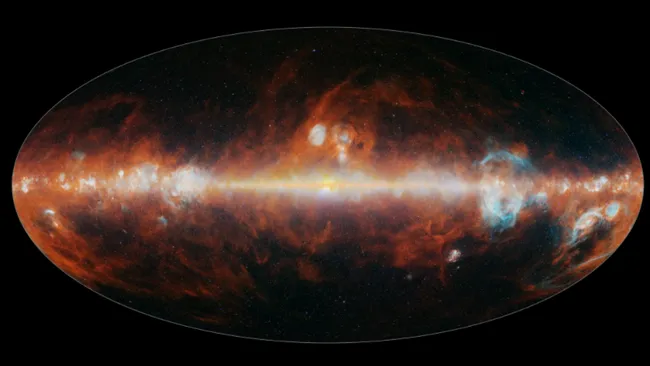
NASA’s SPHEREx telescope has successfully completed its first comprehensive map of the entire sky above Earth, and the results are visually striking. This milestone marks a major step for the NASA SPHEREx mission, which aims to deliver both breathtaking imagery and critical scientific data.
The SPHEREx cosmic map is not only impressive to look at, but it also plays a vital role in addressing major questions about the universe. Scientists plan to use this data to explore what occurred during the earliest moments after the Big Bang. These insights may explain how those initial events shaped the three-dimensional arrangement of hundreds of millions of galaxies.
Beyond the early universe, the first full-sky map SPHEREx provides will help researchers study how galaxies have evolved over the last 13.8 billion years. This includes tracing how essential elements for life were spread across the cosmos.
NASA officials emphasized the scale of information gathered in a short time. According to Shawn Domagal-Goldman, Director of the Astrophysics Division at NASA Headquarters, SPHEREx has collected an extraordinary amount of data within just six months. He noted that the mission effectively produced 102 complete sky maps, each captured at a different wavelength and offering unique details about observed objects.
Domagal-Goldman stated that nearly every astronomer will find valuable insights within this dataset. He added that NASA SPHEREx telescope observations help the global scientific community answer fundamental questions about the universe’s origins and its transformation into a place capable of supporting life.
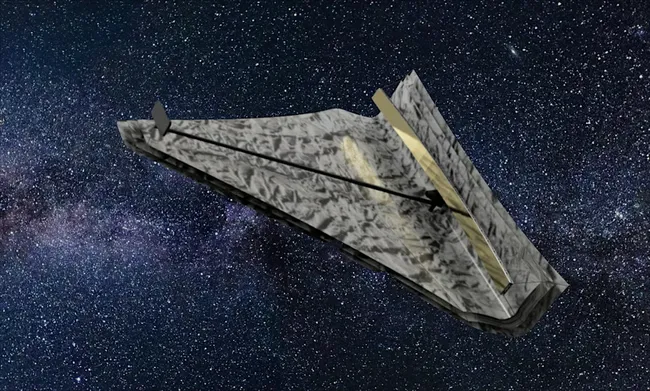
SPHEREx, short for Spectro-Photometer for the History of the Universe, Epoch of Reionization, and Ices Explorer, follows a polar orbit that takes it from the North Pole to the South Pole nearly 15 times each day. During every orbit, the spacecraft captures around 3,600 images as Earth’s movement around the Sun gradually shifts its viewing angle.
After beginning scientific operations in May, SPHEREx required several months to complete its first all-sky survey. Over its two-year primary mission, the observatory is expected to conduct three additional full-sky scans. These future observations will be combined with the existing SPHEREx all-sky survey to create an even more detailed cosmic map.
JPL Director Dave Gallagher described the project as a mid-sized astrophysics mission delivering outsized scientific impact. He highlighted SPHEREx as a clear example of transforming ambitious ideas into reality while unlocking vast potential for discovery.