Astronomers may have identified the first known example of a superkilonova, an extreme cosmic explosion involving a double star system. The finding is linked to a gravitational wave signal detected on August 18, 2025, which immediately drew global scientific attention.
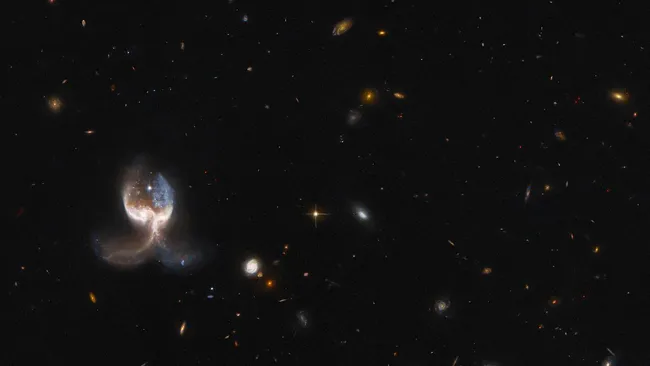
A standard kilonova occurs when two neutron stars collide. These neutron stars are the dense remnants left after massive stars die. Their merger creates conditions violent enough to form elements heavier than iron, including gold and silver. This process represents one of the rare ways such heavy elements arise in the universe.
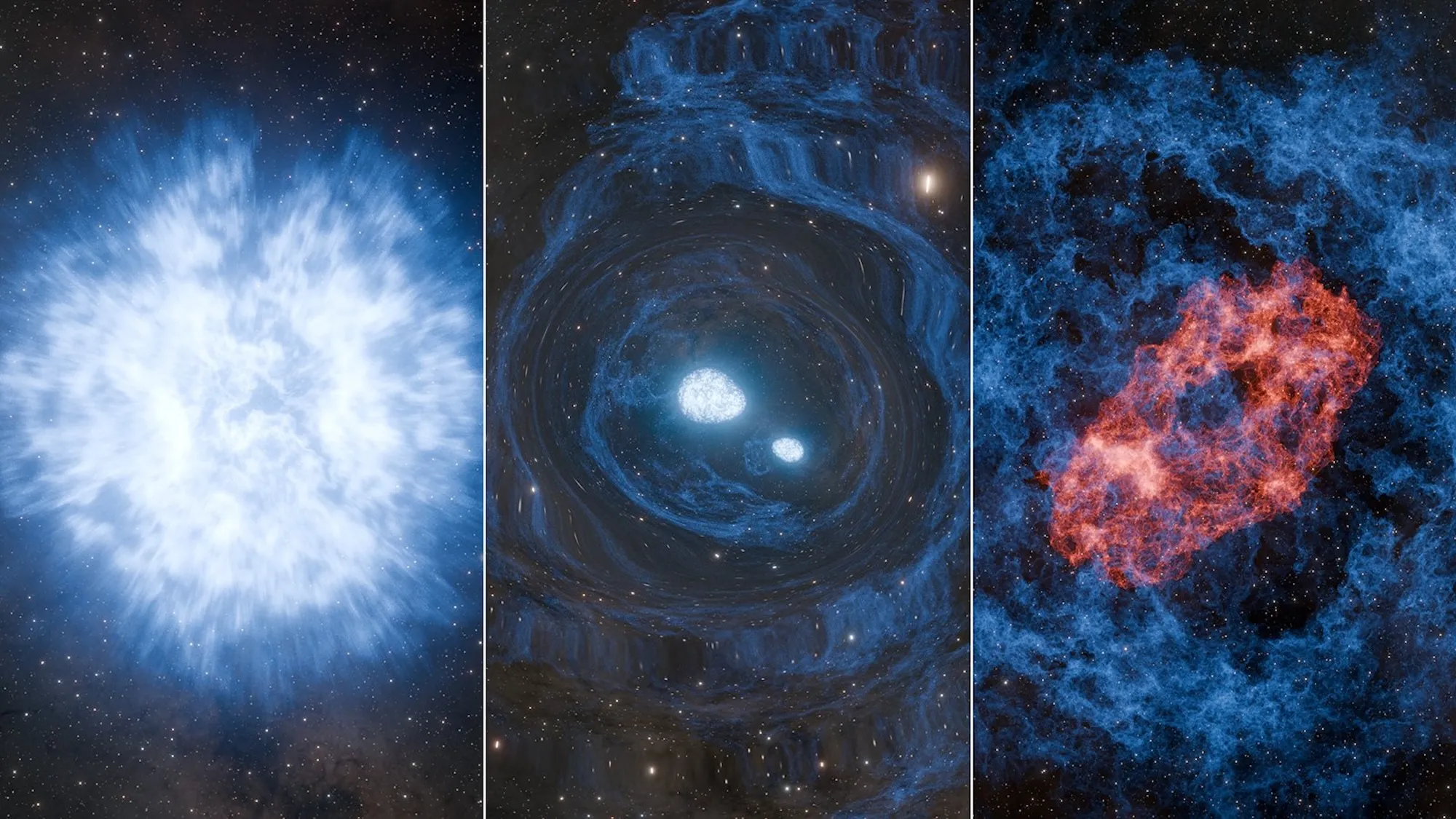
A superkilonova, however, follows a far more complex path. Instead of beginning with a single stellar death, it starts with a supernova that gives birth to two neutron stars at once. These compact objects then spiral toward each other, emitting intense gravitational waves before merging in a powerful blast of electromagnetic radiation.
Until now, astronomers had clearly detected only one kilonova. In 2017, the LIGO and Virgo observatories recorded the gravitational wave event known as GW170817. That signal was later observed across the electromagnetic spectrum by both space-based and ground-based telescopes.
Excitement surged again when LIGO and Virgo registered a new signal labeled AT2025ulz. At first, the event appeared to mark only the second confirmed neutron star merger. Shortly after detection, astronomers worldwide received an alert. The Zwicky Transient Facility at California’s Palomar Observatory quickly identified a rapidly fading red object located about 1.3 billion light-years away, matching the gravitational wave source.
According to study lead author Mansi Kasliwal of the California Institute of Technology, the early behavior of the event closely resembled the 2017 kilonova. For several days, observations matched expectations. Later, the signal began to resemble a supernova, leading some researchers to lose interest. Kasliwal’s team continued their analysis.
Further study suggested the kilonova may have been hidden behind debris from a supernova explosion. This scenario would place AT2025ulz in the category of a superkilonova, a phenomenon long predicted but never directly observed.
Additional telescope data from facilities such as the W. M. Keck Observatory in Hawai‘i and the Fraunhofer telescope in Germany revealed a familiar pattern. The light from AT2025ulz faded quickly and left a red afterglow. This behavior mirrors GW170817 and occurs when heavy elements block blue light while allowing red wavelengths to pass.
Days later, however, the object brightened again and shifted toward blue wavelengths. Hydrogen emission lines also appeared, which are typical of supernovae rather than kilonovae. This created a major puzzle. A supernova at such a distance should not generate gravitational waves strong enough for LIGO to detect.
While many researchers leaned toward a conventional supernova explanation, Kasliwal’s team noted unusual clues. The gravitational wave data suggested one neutron star involved had a mass smaller than the sun. Normally, neutron stars range from 1.2 to two solar masses. This hinted that unusually small neutron stars may have merged.
Scientists have proposed two ways such low-mass neutron stars could form. In one scenario, a rapidly spinning star undergoing a supernova splits into two sub-solar neutron stars. In another, a fast-spinning star explodes and leaves behind a neutron star surrounded by a disk of material that later forms a second neutron star.
In both cases, the neutron stars orbit each other, releasing gravitational waves that drain energy and force them together. Their merger produces heavy elements and the red glow detected by telescopes. Eventually, debris from the original supernova expands and blocks the kilonova from view.
Brian Metzger of Columbia University explained that theory allows sub-solar neutron stars only during the collapse of a rapidly rotating star. If such stars merge, the event may appear as a supernova rather than a standalone kilonova.
At present, astronomers lack sufficient data to confirm AT2025ulz as a true superkilonova. Future observations will be essential. Researchers plan to analyze data from upcoming surveys and observatories to identify similar events.
Kasliwal emphasized that future kilonovae may not resemble GW170817 and could easily be misclassified. While certainty remains elusive, the AT2025ulz event has already expanded scientific understanding and challenged existing models of stellar explosions.