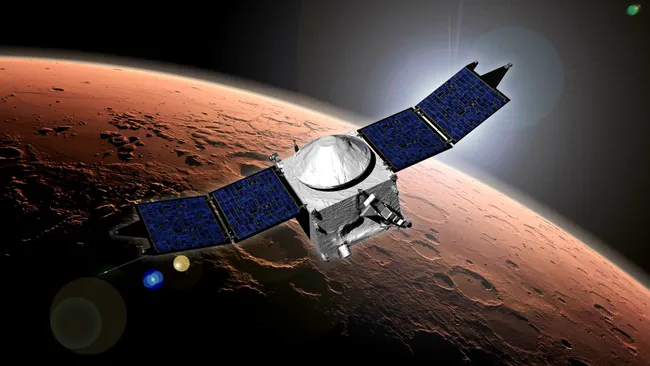
NASA’s MAVEN spacecraft remains unresponsive while orbiting Mars, raising serious concerns about the future of the mission. The orbiter has been silent since December 4, despite multiple attempts by engineers to reestablish contact.
An update released by NASA on Monday, December 15, revealed that a fragment of tracking data was recovered two days after contact was lost. That limited signal provided further troubling indications about the condition of the NASA MAVEN spacecraft.
According to NASA officials, analysis of the recovered data suggests MAVEN was rotating in an unexpected way as it emerged from behind Mars. In addition, the frequency detected in the signal indicates that MAVEN’s orbital trajectory may no longer be nominal.
MAVEN, which stands for Mars Atmosphere and Volatile Evolution, was launched in November 2013. The spacecraft successfully entered Mars orbit roughly ten months later to begin its primary science mission.
The Mars atmosphere mission MAVEN was designed to study the planet’s upper atmosphere and its interaction with the solar wind. This stream of charged particles from the sun plays a key role in shaping atmospheric loss over time.
MAVEN’s prime mission lasted one Earth year and delivered significant scientific results. Data from the orbiter helped researchers determine how and when Mars lost most of its thick atmosphere, a change that ended the planet’s ability to sustain flowing liquid water billions of years ago.
After completing its initial objectives, MAVEN continued operating far beyond expectations. The spacecraft collected extensive information on Martian dust storms, atmospheric winds, and auroras.
Beyond science, MAVEN silent at Mars now affects its secondary role as a communications relay. The orbiter has been supporting data transmission between Earth and surface missions, including the Curiosity and Perseverance rovers.
However, MAVEN is not the only relay asset in Mars orbit. NASA’s Mars Reconnaissance Orbiter and Mars Odyssey also provide communications support. In addition, the European Space Agency operates Mars Express and the ExoMars Trace Gas Orbiter, all of which remain fully operational.
NASA stated that contingency measures are already in place. For the next two weeks of scheduled surface operations, additional relay passes will be handled by the remaining orbiters.
The Perseverance and Curiosity teams have adjusted their daily planning to maintain science operations. NASA officials emphasized that rover missions will continue despite the MAVEN orbit anomaly.
For now, engineers continue assessing the situation as MAVEN unexpected rotation remains a critical concern. No timeline has been provided for restoring contact, and the spacecraft’s status remains uncertain.