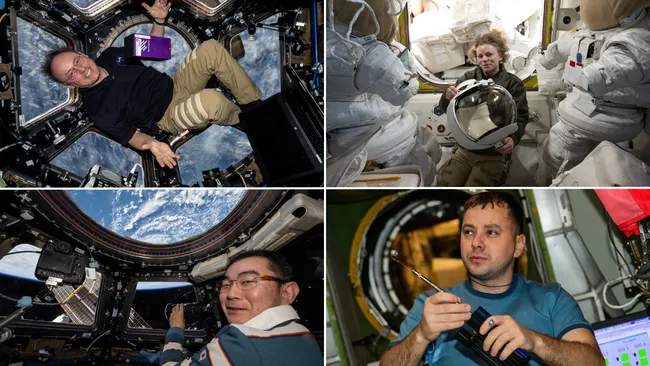
NASA has announced it will bring four astronauts back to Earth earlier than planned, marking the first medical evacuation in the history of the International Space Station. The decision follows a medical issue experienced by one crewmember during SpaceX’s Crew-11 mission.
The space agency confirmed on Thursday (Jan. 8) that all four Crew-11 astronauts will depart the ISS ahead of schedule. Officials emphasized that the situation is stable and does not constitute an emergency. The affected astronaut is reported to be in good condition.
NASA Administrator Jared Isaacman stated that the return is not an emergency de-orbit, despite the agency maintaining that capability at all times. He explained that NASA and its partners routinely train for such scenarios. The accelerated return was chosen because proper diagnosis and treatment capabilities are limited aboard the ISS.
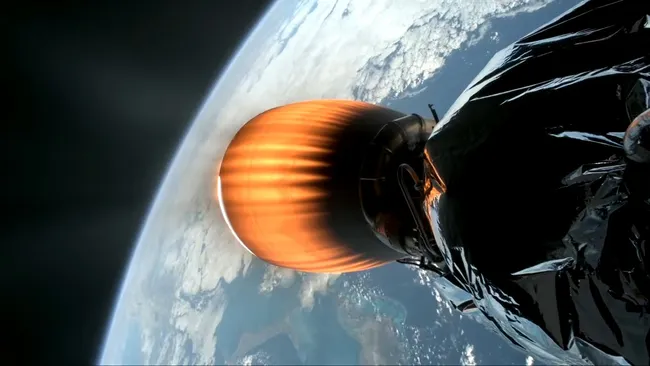
Crew-11 is composed of NASA astronauts Zena Cardman and Michael Fincke, Japan Aerospace Exploration Agency astronaut Kimiya Yui, and Roscosmos cosmonaut Oleg Platonov. The crew launched to the station aboard SpaceX’s Crew Dragon Endeavour on Aug. 1, 2025.
The team is already close to completing its planned six-month stay in orbit. According to Isaacman, most mission objectives have been successfully achieved. He added that the upcoming launch of Crew-12 in the coming weeks also made the timing suitable for an early return.
While the exact departure date has not been finalized, NASA expects to provide an updated timeline within the next few days. The medical concern first became public on Wednesday (Jan. 7), when NASA postponed a scheduled spacewalk involving Cardman and Fincke.
NASA has not disclosed which astronaut is affected or provided detailed medical information, citing privacy considerations. However, NASA’s Chief Health and Medical Officer, Dr. James Polk, clarified that the issue is unrelated to operational duties or spacewalk preparations.
Polk explained that the condition is associated with the challenges of diagnosing medical issues in a microgravity environment using limited onboard equipment. He also noted that statistical models suggest medical evacuations from the ISS are expected roughly once every three years.
Crew-12, the next four-astronaut mission, is currently targeted for launch in mid-February. Although NASA is evaluating whether that timeline can be accelerated, Crew-12 is unlikely to arrive before Crew-11 departs.
Following Crew-11’s return, the ISS is expected to operate temporarily with a reduced crew. NASA astronaut Christopher Williams and Roscosmos cosmonauts Sergey Kud-Sverchkov and Sergei Mikayev, who arrived aboard a Soyuz spacecraft on Nov. 27, will remain on board.
Williams will serve as the only American astronaut on the station during this period. NASA Associate Administrator Amit Kshatriya stated that Williams is fully trained to handle all required tasks. He added that mission control teams around the world will continue to support station operations and scientific research throughout the transition.