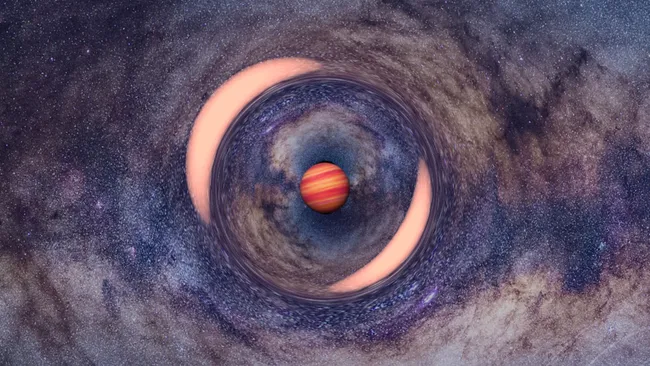
Astronomers have confirmed the existence of a rare free-floating exoplanet drifting through space without a host star. The rogue planet lies almost 10,000 light-years from Earth and has a size comparable to Saturn.
Rogue planets are worlds that wander independently rather than orbiting stars. For decades, their nature has remained largely unclear due to the difficulty of observing such faint objects.
Most known planets remain gravitationally bound to stars. However, early signs of a rogue planet were reported in 2000, marking the first indication that some planets travel alone through the galaxy.
In 2024, researchers observed an object that distorted the light of a distant star. The event was recorded simultaneously from Earth-based observatories and space using the European Space Agency’s Gaia telescope.
These combined observations allowed scientists to identify the object as a free-floating exoplanet. Its estimated distance reaches about 9,950 light-years from Earth toward the center of the Milky Way.
The newly confirmed rogue planet carries a mass roughly 70 times that of Earth. By comparison, Saturn has a mass close to 95 Earths.
According to the research team, free-floating exoplanets may be far more common than previously assumed. Theoretical models suggest their numbers in the Milky Way could exceed the total number of stars.
Scientists believe studying rogue planet discovery cases can help explain how planetary systems evolve. Chaotic interactions in young systems may eject planets into interstellar space.
Passing stars can also destabilize planetary orbits and send worlds drifting away. Some free-floating planets may even form independently from gas and dust clouds, similar to stars.
Detecting these objects remains extremely challenging. Rogue planets emit little to no light, placing them beyond the reach of most current telescopes.
At present, astronomers rely on gravitational microlensing to identify them. When a rogue planet crosses in front of a distant star, its gravity briefly amplifies the star’s brightness.
Using this method, researchers have identified about a dozen rogue planet candidates. However, microlensing alone usually cannot determine distance or mass with precision.
This limitation has left many uncertainties, including whether detected objects were true planets or brown dwarfs. The latest discovery overcomes that challenge.
By observing the same microlensing event from different locations, scientists triangulated the planet’s distance from Earth. This breakthrough also enabled a reliable mass estimate.
The event is cataloged as KMT-2024-BLG-0792 and OGLE-2024-BLG-0516. Its confirmation strengthens evidence that the Milky Way may be filled with rogue planets.
Future missions could dramatically expand this field of study. NASA’s Nancy Grace Roman Space Telescope is expected to survey the sky far faster than Hubble.
China’s planned Earth 2.0 mission will also search for free-floating planets. These efforts could reveal many more wandering worlds.
Researchers say the outlook for rogue planet science continues to improve. Each discovery brings astronomers closer to understanding how planets form, evolve, and sometimes drift alone through the galaxy.