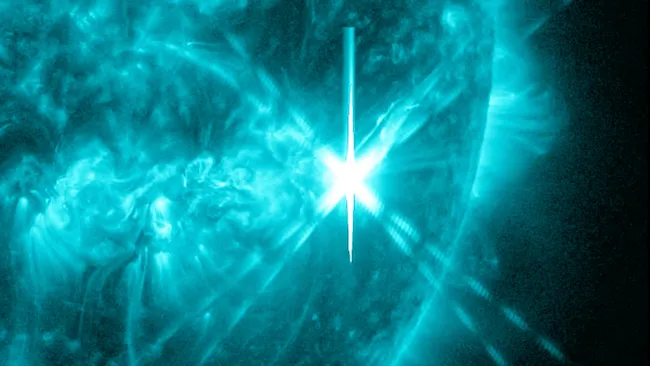
Sun unleashed a powerful X1.1-class solar flare early this morning, briefly disrupting radio communications across Australia and parts of Southeast Asia. The eruption peaked at 12:01 a.m. EST (0501 GMT) and originated from sunspot AR4298 as it moved toward the sun’s western limb. The region is expected to rotate out of sight in the coming days.
A coronal mass ejection also erupted alongside the flare as a plume of plasma and magnetic field surged into space. Early satellite coronagraph assessments indicate the CME is not directed at Earth. The X1.1 solar flare arrived during an already active week for solar activity. Several previous CMEs are forecast to strike Earth between December 8 and 9, leading NOAA’s Space Weather Prediction Center and the U.K. Met Office to issue geomagnetic storm watches. Forecasts include the possibility of G2–G3 level storming, raising the chance of auroras at high and mid-latitudes.
Solar flares occur when magnetic energy in the sun’s atmosphere builds up and releases an intense burst of electromagnetic radiation. They are classified by strength into lettered groups: X-class as the strongest, M-class at ten times weaker, and C, B, and A-class decreasing in magnitude with A-class typically showing no impact on Earth. The numerical value within each group identifies the flare’s relative intensity, with the December 8 eruption measured at X1.1.
Radio blackouts occur when a flare’s radiation ionizes Earth’s upper atmosphere. High-frequency radio waves normally reflect off the ionosphere’s higher layers to travel long distances. During a strong flare, however, the lower and denser ionospheric layers become heavily ionized, causing radio waves to collide more frequently with particles and lose energy. Radio signals may weaken, distort, or vanish entirely under these conditions as described by NOAA.