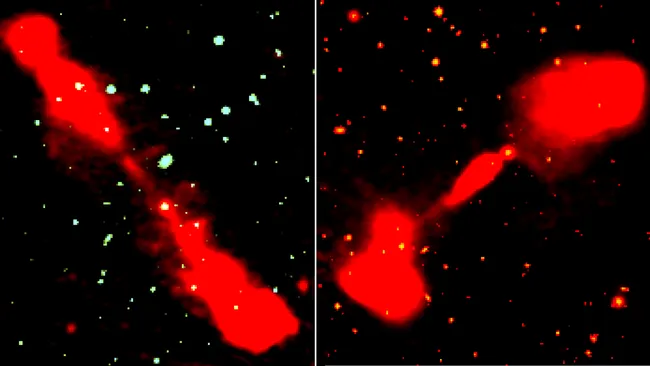
Astronomers have discovered 53 powerful quasars powered by supermassive black holes that are blasting out near-light-speed jets of matter stretching up to 7.2 million light-years—a distance around 50 times the width of the Milky Way.
These monster objects, identified as Giant Radio Quasars, were part of a larger clutch of 369 radio quasars recently discovered by Indian astronomers using data from the Giant Meterwave Radio Telescope (GMRT), located near Pune, India, as part of the TIFR GMRT Sky Survey (TGSS).
“The sizes of these radio jets are not comparable to our solar system or even our galaxy,” said team member Souvik Manik. “We are talking about 20 to 50 Milky Way diameters placed side by side.”
How Giant Radio Quasars Work
Quasars are extremely powerful galactic cores, also known as Active Galactic Nuclei (AGN), powered by central supermassive black holes. When these black holes are surrounded by gas and dust, they feed on this matter via an accretion disk, which heats up and emits radiation.
Not all matter is consumed; strong magnetic fields channel highly ionized gas (plasma) to the black hole’s poles, accelerating it to near-light speeds and blasting it out as powerful twin jets. These jets spread out into wide plumes, or “lobes,” millions of light-years away and are accompanied by strong radio wave emissions.
Team leader Sabyasachi Pal explained that these Giant Radio Quasars are valuable for understanding the late stages of black hole evolution and the intergalactic medium (the tenuous gas confining their lobes).
Environmental Influence and Asymmetry
The researchers found an interesting trend: at least 14% of these gigantic objects reside within galaxy clusters and near cosmic filaments, suggesting that the environment plays a major role in shaping their evolution.
“In denser regions, the jets might be slowed down, bent, or disrupted by the surrounding gas, while in emptier regions, they can grow freely across the intergalactic medium,” said team member Netai Bhukta.
The scientists also noted that the twin jets frequently display radio jet asymmetry (uneven length or brightness). This asymmetry indicates that the jets are battling against an uneven cosmic environment, where one side may be encountering denser intergalactic gas, slowing its growth, while the other expands freely. The team’s findings indicate that more distant giant quasars—which are viewed further back in time—show greater jet asymmetry, possibly because the early universe was more chaotic and packed with denser gas that distorted the jets’ paths.