A newly discovered comet has received an extraordinary level of scientific attention after being tracked almost nonstop by one of NASA’s latest spacecraft. For nearly 40 days, the PUNCH mission monitored Comet C/2025 R2 (SWAN) as it traveled through the inner solar system.
NASA confirmed that the spacecraft captured images of the comet every four minutes. This level of continuous observation is believed to be the longest high-frequency tracking of any comet ever achieved.
According to PUNCH principal investigator Craig DeForest, most previous comet observations were limited to daily tracking. The ability to monitor motion and tail behavior minute by minute marks a major step forward in heliophysics research.
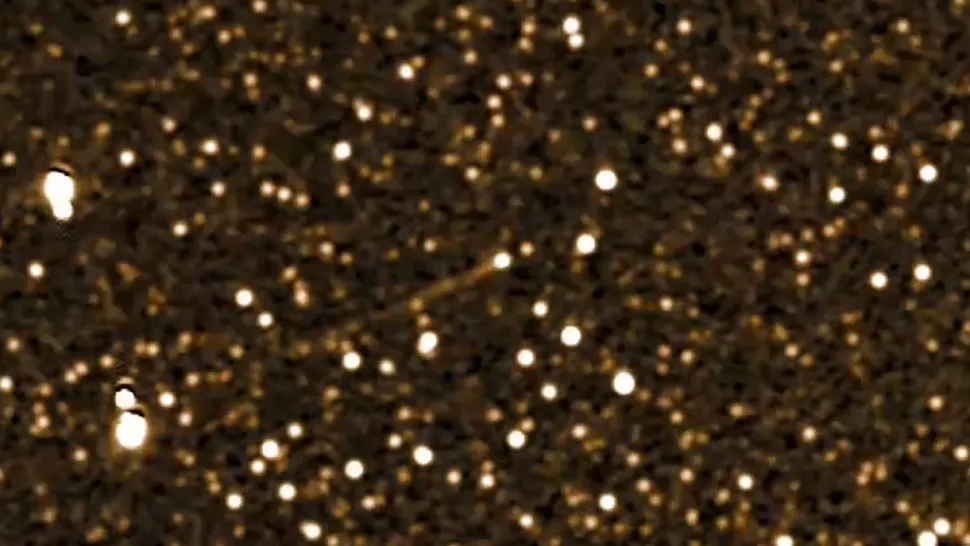
The full timelapse was created from hundreds of images recorded between August 25 and October 2. Within the sequence, the comet can be seen drifting between Mars and the bright star Spica in the Virgo constellation. Thin black borders remain visible because the frames were combined before full processing.
Comet C/2025 R2 (SWAN) was first detected in September by Ukrainian amateur astronomer Vladimir Bezugly. He identified the object as a bright blur near the sun while analyzing publicly available data from the SOHO space observatory.
Just one day after discovery, the comet reached perihelion. At that point, it passed within 46.74 million miles of the sun, triggering strong outgassing as solar heat vaporized its surface ice.
Early imagery revealed a striking bluish-green coma produced by sublimation. Gas and dust released from the nucleus were driven backward by the solar wind, forming a glowing tail that evolved rapidly over time.
By mid-September, the coma developed an unusual triangular hammerhead shape. Astronomers associate this type of distortion with fragmentation, as multiple active pieces can pull the coma into irregular forms.
At the same time, Comet SWAN occupied the same region of the sky as the interstellar object 3I/ATLAS. The object briefly appeared near the end of the PUNCH timelapse, streaking from left to right beneath the comet.
As SWAN moved leftward through the image sequence, its tail was also forced in that direction by the solar wind. This created the illusion that the comet was drifting backward across space.
Scientists use comet tails as natural probes of solar wind behavior. These charged particle streams flow continuously from the sun and shape space conditions throughout the solar system.
NASA heliophysicist Gina DiBraccio explained that observing solar effects from multiple vantage points is essential to understanding the broader space environment. The same data helps researchers evaluate how space weather affects astronauts, satellites, and technology on Earth.
In late October, Comet C/2025 R2 (SWAN) made its closest approach to Earth at a distance of 25.10 million miles. At that range, the comet reached the threshold of naked-eye visibility and became an easy target for binoculars and small telescopes.
The extended observation campaign has provided scientists with rare insight into both comet dynamics and solar wind behavior. The presence of an interstellar object within the same field of view only made the event more extraordinary.