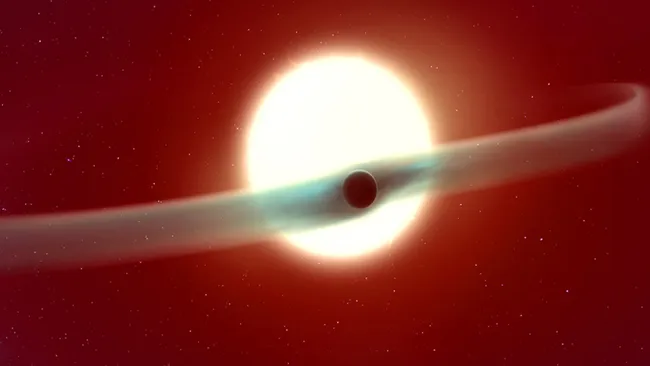
James Webb Space Telescope (JWST) has uncovered a striking phenomenon on the hot Jupiter exoplanet WASP-121b, also called Tylos. Astronomers discovered two exceptionally long helium tails leaking from the planet, forming structures so unusual that current scientific models fail to explain them. This marks the first full-orbit observation of gases escaping from an exoplanet, offering the most complete atmospheric escape study ever achieved. The targeted world, located 858 light-years away, belongs to the class of ultrahot Jupiters, massive gas giants orbiting extremely close to their parent stars.
WASP-121b completes an orbit every 30 hours, exposing its atmosphere to intense stellar radiation that heats it to around 4,200 degrees Fahrenheit (2,300 degrees Celsius. Under such extreme heating, lighter gases like hydrogen and helium rise and drift into space, a gradual atmospheric escape process that transforms the planet’s size and composition. Scientists previously observed glimpses of atmospheric escape only during brief transits when planets passed in front of their stars. This limited view left major gaps regarding whether the escape continued throughout the orbit. These new JWST observations, collected using the NIRSpec instrument during a continuous 37-hour session, deliver the first uninterrupted tracking of helium behavior across a complete exoplanet orbit.
Lead researcher Romain Allart stated that the team was astonished by the duration of the helium leakage. He emphasized the complexity of the physical processes shaping exoplanet atmospheres and how they interact with stellar environments, noting that researchers are only beginning to grasp the depth of these dynamics. The observation stands out as the longest continuous detection of atmospheric escape to date, as helium around WASP-121b extended far beyond the planet for more than half its orbit.
The most remarkable discovery is the presence of dual helium tails. One tail trails behind WASP-121b, pushed away by radiation and stellar winds. The second tail astonishingly leads the planet, apparently pulled forward by the star’s gravity. Together, the twin gas tails reach lengths 100 times the planet’s diameter and span distances more than three times the separation between the hot Jupiter and its star. Scientists currently have no model capable of explaining how these two opposite-facing structures form simultaneously.
Researcher Vincent Bourrier emphasized that new observations often reveal gaps in existing models and force astronomers to explore new mechanisms. The JWST helium tails detected on WASP-121b now challenge scientists to reevaluate assumptions about atmospheric loss, stellar interaction, and exoplanet evolution across extreme environments.