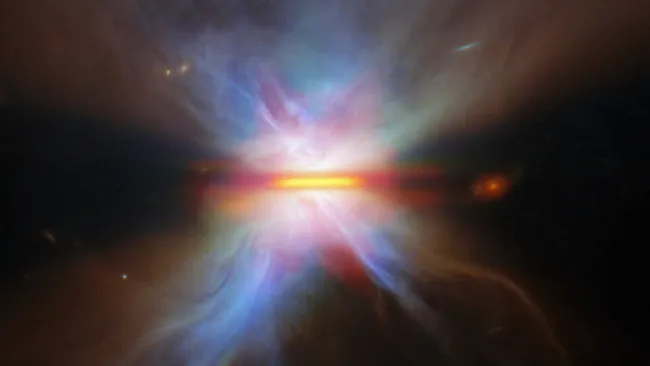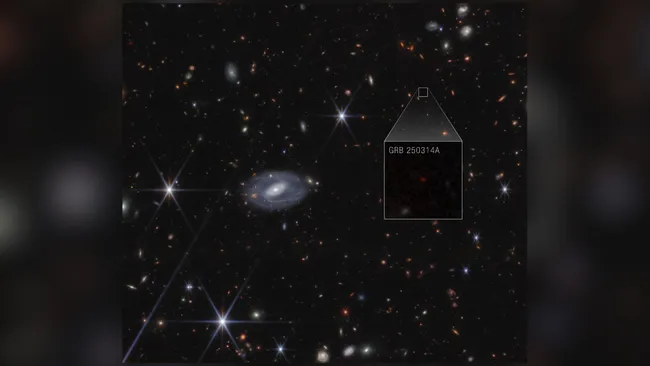
reports that the James Webb Space Telescope (JWST) has detected light from the most ancient supernova ever recorded, originating 13 billion years ago — just 730 million years after the Big Bang. This stellar explosion was paired with a powerful gamma-ray burst (GRB), signaling the violent death of a massive star and potentially the formation of a stellar-mass black hole.
According to Andrew Levan of Radboud University and the University of Warwick, only a few GRBs have ever been detected from within the first billion years of the universe, making this event exceptionally rare.
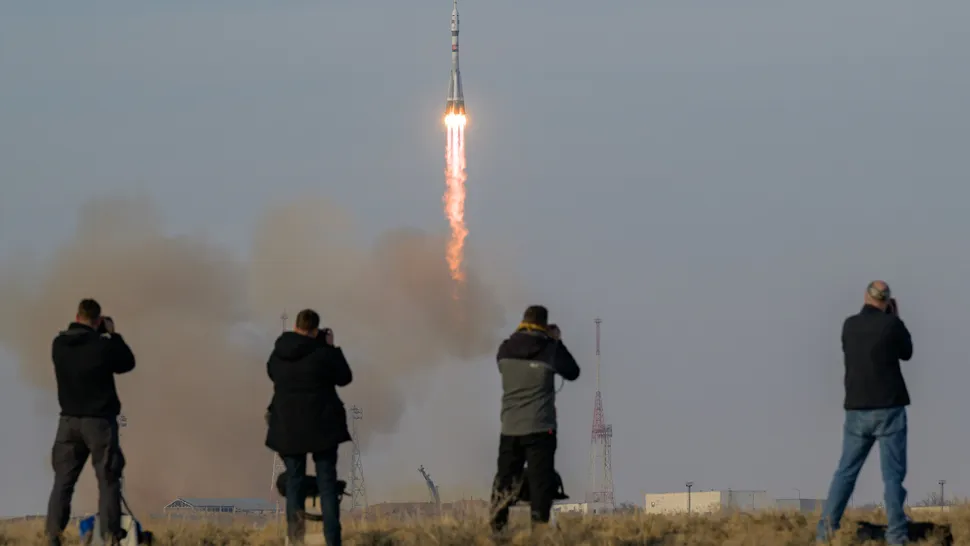
The discovery began on March 14 when the Franco-Chinese SVOM satellite identified a gamma-ray flash from deep space. Ninety minutes later, NASA’s Neil Gehrels Swift Observatory detected the same event in X-rays, allowing astronomers to pinpoint the source of GRB 250314A.
Eleven hours after the Swift detection, the Nordic Optical Telescope on La Palma observed the faint afterglow produced as material ejected from the dying star collided with surrounding gas. Four hours later, the Very Large Telescope in Chile confirmed a redshift of 7.3 — placing the explosion 13 billion years in the past.
Because of cosmic expansion, the supernova’s brightening appears stretched over time. Instead of reaching peak brightness within days or weeks, it appears to peak three and a half months later from Earth’s perspective.
With this timing in mind, Levan’s team secured Director’s discretionary time on JWST. On July 1, JWST’s Near-Infrared Camera successfully captured the supernova’s light.
“Only Webb could directly show that this light is from a supernova — a collapsing massive star,” Levan stated, emphasizing how JWST enables astronomers to study individual stars when the universe was just 5% of its current age.
JWST also identified the supernova’s host galaxy, which appears faint and blurred over only a few pixels. Despite this, astronomers can still infer characteristics of the galaxy. Emeric Le Floc’h of CEA Paris-Saclay notes that the galaxy resembles other early-era galaxies in structure and composition.
The spectrum of the supernova mirrors that of modern stellar explosions, implying the progenitor star was similar in mass to massive stars observed today. However, given the lower abundance of heavy elements in that early cosmic era, astronomers expect subtle differences that will require more data to uncover.
This discovery is a milestone — the most distant supernova ever observed and one of only a few GRBs detected from the universe’s first billion years. The previous record, also set by JWST, was a supernova that exploded 1.8 billion years after the Big Bang. The new redshift 7.3 event surpasses that record by a wide margin.