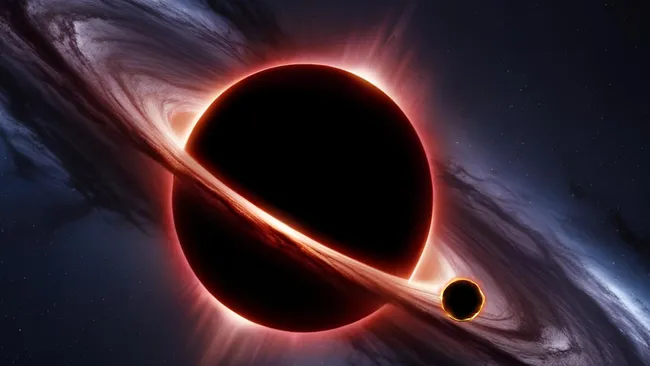
Scientists may have “heard” the first tantalizing hints of long-theorized Primordial black holes born during the Big Bang. This potential detection, involving tiny black holes that could be the size of a coin or even smaller, comes from the detection of spacetime ripples called gravitational waves by the Earth-based Laser Interferometer Gravitational-wave Observatory (LIGO) and Virgo detectors.
On November 12, the LIGO-Virgo-KAGRA collaboration issued an automated alert for a black hole merger—designated S251112cm—that was highly unusual.
The Subsolar Mass Anomaly
The signal revealed that one of the objects involved had a mass that was too small to be classified as either a conventional stellar-mass black hole or a neutron star, both of which are stellar remnants with masses greater than the Sun. This size is referred to as a Subsolar mass source.
“If this turns out to be real, then it’s enormous,” said theoretical physicist Djuna Croon. “This is not an event we can explain by conventional astrophysical processes.”
The University of Glasgow researcher and LIGO team member, Christopher Berry, shared the alert, noting its potential origin from a subsolar mass source. However, he later added that there is a significant chance the signal is a false alarm, resulting from noise in the detectors. For a signal as rare as S251112cm, this possibility casts a large shadow of doubt.
What Are Primordial Black Holes?
Primordial black holes are theorized to have formed directly from overly dense pockets in the hot plasma that filled the universe in the first few seconds after the Big Bang, long before the first stars existed. They are often called “non-astrophysical black holes” because their creation does not rely on stars.
Their theorized mass range is vast, but it includes the “sub-stellar masses” detected in S251112cm. If they exist, primordial black holes are a compelling Dark matter candidate because their existence is consistent with the Standard Model of particle physics and they interact only via gravity, fitting the criteria for dark matter which accounts for around 85% of all matter in the universe.
The Search Continues
According to Stephen Hawking’s theory of Hawking Radiation, very light black holes could have evaporated quickly. If S251112cm is real, it suggests some larger examples of primordial black holes still exist.
The current challenge is confirming the signal. The LIGO-Virgo collaboration was only able to narrow down the source of the signal to a huge region of the sky, making the search for an accompanying electromagnetic explosion extremely difficult—akin to searching for a needle in a cosmic haystack.
For now, researchers must rely solely on analyzing the gravitational wave signal itself. Though the chance is slim, the detection of more similar signals would be needed to know with certainty if primordial black holes have truly been found.