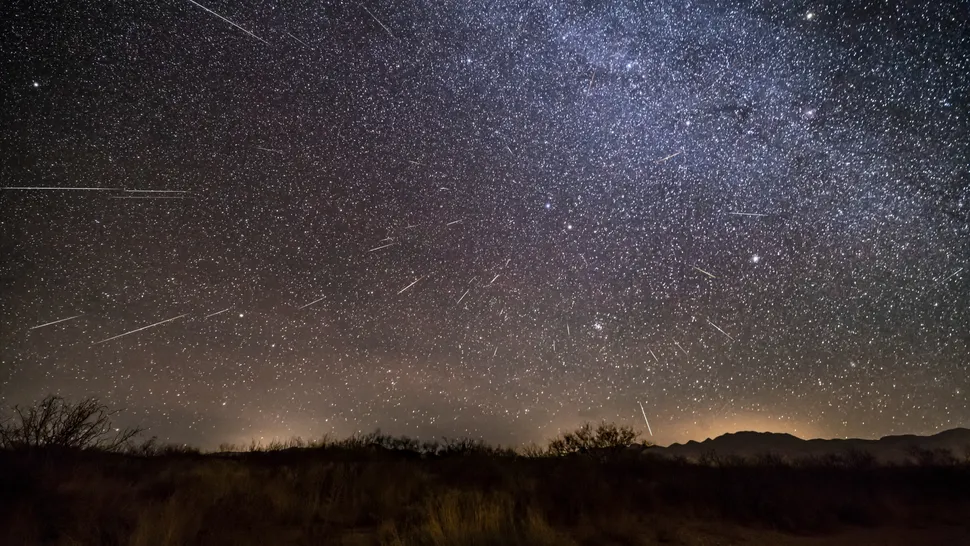
The Geminid meteor shower peaks overnight tonight, December 13–14, offering one of the most impressive shooting star displays of the year. As Earth plows through debris left behind by the unusual object 3200 Phaethon, skywatchers may be treated to a vivid celestial show.
At its peak, the Geminid meteor shower 2025 is capable of producing up to 150 meteors per hour, according to the American Meteor Society. Actual viewing rates will vary depending on local conditions, sky darkness, and the time observers head outside. Clear skies and minimal light pollution remain key factors for a successful viewing session.
Shooting stars occur when tiny fragments from comets or asteroids slam into Earth’s atmosphere and vaporize. Even particles no larger than grains of sand can create brief but striking streaks of light. Larger fragments, sometimes measuring more than a meter across, can generate brilliant fireballs that shine brighter than Venus as they cross the sky.
How to see Geminid meteors
The Geminid meteor radiant is located near the bright star Castor in the constellation Gemini. This constellation rises above the eastern horizon of the Northern Hemisphere shortly after sunset on December 13. The meteor shower takes its name from this region of the sky.
Observers may spot a few Geminid meteors as soon as darkness falls, once the radiant climbs above the horizon. Early in the evening, meteors tend to appear lower in the sky and travel westward. These early streaks often skim the atmosphere, allowing them to linger for several seconds instead of the typical brief flash.
Meteor activity increases noticeably after 10 p.m. local time. Under dark skies, up to 30 shooting stars per hour may become visible as the radiant climbs higher. Rates continue to build as the night progresses, making late-night and pre-dawn hours the most productive for watching.
To maximize your chances, locate Castor using a smartphone astronomy app. If needed, Jupiter can serve as a guide, as it shines prominently in Gemini throughout December. Once the radiant is identified, focus on a patch of sky about 30 to 40 degrees above it, where meteor trails appear longest. Three to four clenched fist widths held at arm’s length equal this distance.
As the night advances, meteor counts increase steadily. Near 2 a.m. local time, observers at dark rural sites may see up to 60 Geminid meteors per hour. Viewing conditions become slightly more challenging when a waning crescent moon rises around this time, though many meteors remain visible if the Moon is kept out of view.
For the best experience, allow at least 30 minutes for your eyes to adapt fully to the darkness. Use red light sparingly to preserve night vision. Warm clothing is essential, and a reclining chair or sleeping bag can make long observing sessions far more comfortable.
Astrophotographers hoping to capture the Geminid meteor shower should prepare wide-field setups and long exposures. Proper planning and patience can yield striking images of one of the year’s most reliable and visually rich meteor displays.