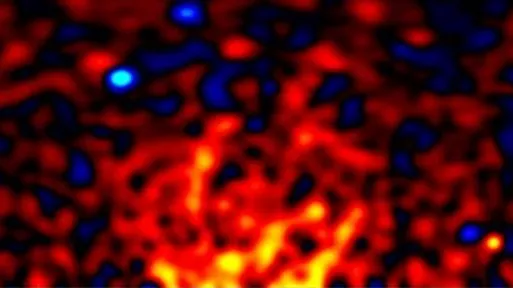
Astronomers may have “seen” Dark matter for the first time, thanks to NASA’s Fermi gamma-ray space telescope. If confirmed, this would mark the first direct detection of the universe’s most mysterious substance, which is estimated to account for 85% of all matter.
Dark matter was first theorized in 1933 by Fritz Zwicky, and later supported by Vera Rubin’s findings in the 1970s, which showed that the visible mass of galaxies was insufficient to explain their rotational dynamics. These were inferences based on gravity, but now, direct detection may be at hand.
The Annihilation Hypothesis
Since dark matter does not emit, absorb, or reflect light, it is effectively invisible. However, one theory suggests a way for it to produce light: if dark matter particles “annihilate” when they collide, similar to matter and antimatter, they should produce a shower of particles, including gamma-ray photons.
One of the theorized “self-annihilating” particles is the Annihilating WIMPs (Weakly Interacting Massive Particles).
A research team led by Tomonori Totani from the Department of Astronomy at the University of Tokyo focused the Fermi spacecraft on the center of the Milky Way, where dark matter is theorized to congregate in vast haloes.
The Telltale Gamma-Ray Signature
Totani and his team believe they have finally found the sought-after signature.
“We detected gamma rays with a photon energy of 20 gigaelectronvolts… extending in a halo-like structure toward the center of the Milky Way galaxy,” Totani stated. “The Gamma-ray signature emission component closely matches the shape expected from the dark matter halo.”
Crucially, the energy signature of these gamma-rays closely matches those predicted to emerge from the annihilation of colliding WIMPs, which are predicted to have a mass about 500 times that of a proton. Totani suggests that no other known astronomical phenomena can easily explain the gamma-rays observed by Fermi.
“If this is correct, to the extent of my knowledge, it would mark the first time humanity has ‘seen’ dark matter,” Totani said.
A New Particle Beyond the Standard Model
Totani suggests this discovery signifies a major development in physics and astronomy, as it indicates that dark matter is a new particle not included in the current standard model of particle physics.
While the team is confident that they have detected the signature of Annihilating WIMPs at the heart of our galaxy, the broader scientific community will require more hard evidence before confirming the discovery.
The team’s research was published on Tuesday (Nov. 25) in the Journal of Cosmology and Astroparticle Physics.