Scientists witnessed a supernova shockwave tearing through the surface of a dying star for the first time, revealing a shockingly symmetrical explosion. This brief but critical moment has long eluded astronomers because supernovas are rarely detected early enough and often occur too far away for detailed study.
Supernova 2024ggi offered a rare chance. It detonated on April 10, 2024, inside the relatively nearby spiral galaxy NGC 3621, located 22 million light-years away in the Hydra constellation. Recognizing the opportunity, Yi Yang of Tsinghua University and his international team quickly secured observing time on the Very Large Telescope (VLT) in Chile. Within 26 hours of its discovery by the ATLAS survey, the VLT was already gathering vital data.
Using VLT observations, researchers captured the phase when matter accelerated by the explosion blasted through the star’s surface. According to ESO’s Dietrich Baade, this short window allowed the team to observe both the star’s geometry and the explosion’s structure simultaneously — something never achieved before.
The doomed star was a massive red supergiant, 12 to 15 times the mass of the sun. These giants collapse when they can no longer sustain nuclear fusion in their core. The core collapses into a neutron star, the surrounding layers crash inward, and the resulting rebound drives the catastrophic dying star explosion. Because the star’s radius was enormous — roughly 500 times the sun’s — the shockwave needed an entire day to reach its visible surface.
This exact moment of “shock breakout” is critical for understanding how a star destroys itself from the inside out. Although the event appeared only as a point of light, the team analyzed the polarization of that light using the VLT’s FORS2 spectrograph with a technique called spectropolarimetry. This method uncovers geometric information invisible to other observations.
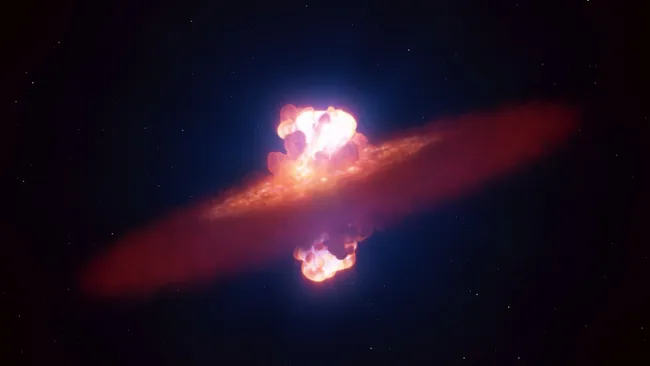
The readings showed that the shock breakout had a slightly flattened shape, resembling an olive or grape. Despite this, the first supernova observation of its kind showed the explosion propagated symmetrically — even as it slammed into surrounding circumstellar material.
The symmetry challenges certain supernova models. For instance, theories involving neutrino absorption predict highly asymmetrical explosions, which doesn’t match the data. Instead, if asymmetry appears at later stages, the team suggests it may be caused by strong magnetic fields rather than neutrinos.
These findings reshape how scientists understand symmetrical supernova explosions and the physical mechanisms behind them, allowing astronomers to refine models of how massive stars end their lives. The results from SN 2024ggi were published on Nov. 12 in Science Advances, and the paper is accessible on the ESO website.