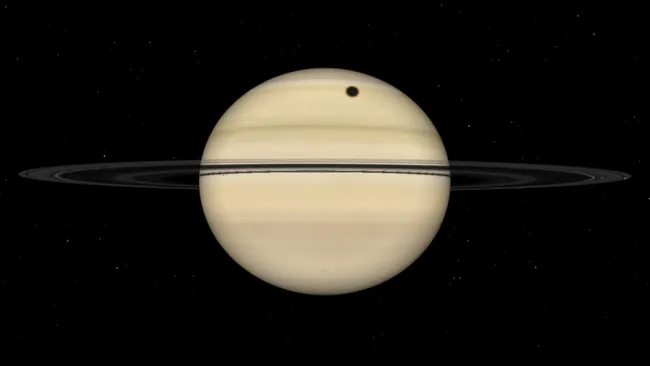
Grab your telescope and aim it at Saturn in the early morning hours of August 19 to see Titan’s colossal shadow sweep across the majestic gas giant’s cloud tops.
This rare shadow transit is visible during a few brief windows every 15 years, when Saturn’s rings are aligned edge-on with Earth. During this time, the orbital plane of Saturn’s largest moon, Titan, is well aligned to cast its mighty shadow over the gas giant’s cloud tops.
Each Titan shadow transit is separated by a period of 16 days, equal to the amount of time it takes for the moon to complete a full lap of its parent planet. The next transit begins at 1:52 a.m. ET (0552 GMT) on August 19. From there, the moon’s shadow takes a little over four hours to sweep across Saturn’s disk, according to Sky & Telescope.
Saturn can be found shining around 40 degrees above the southeastern horizon as the transit kicks off on August 19. For reference, the width of your clenched fist held at arm’s length accounts for roughly 10 degrees in the night sky.
At that time, the gas giant will be approximately 807 million miles (1.3 billion kilometers) from Earth, rendering the event invisible to both the naked eye and binoculars alike. However, an 8-inch telescope at 200x magnification should provide a clear view of Titan’s shadow on Saturn’s surface, according to Hayden Planetarium instructor and lecturer Joe Rao. It may also be possible to track the transit using a smaller 4-inch scope, though this would be challenging even under excellent atmospheric conditions.
Upcoming Titan Shadow Transits (timings from Sky & Telescope in ET)
- Aug 3 – 2:25 a.m. to 7:04 a.m.
- Aug 19 – 1:52 a.m. to 6:00 a.m.
- Sept 4 – 1:25 a.m. to 4:50 a.m.
- Sept 20 – 1:09 a.m. to 3:34 a.m.
- Oct 6 – 1:32 a.m. to [end not provided]
Once Titan’s shadow exits Saturn’s disk after October 6, the next opportunity won’t come until this alignment recurs, likely in the mid-2040s.